Old Stones, New Puzzles: UK Escape Rooms That Live in Buildings With a Backstory
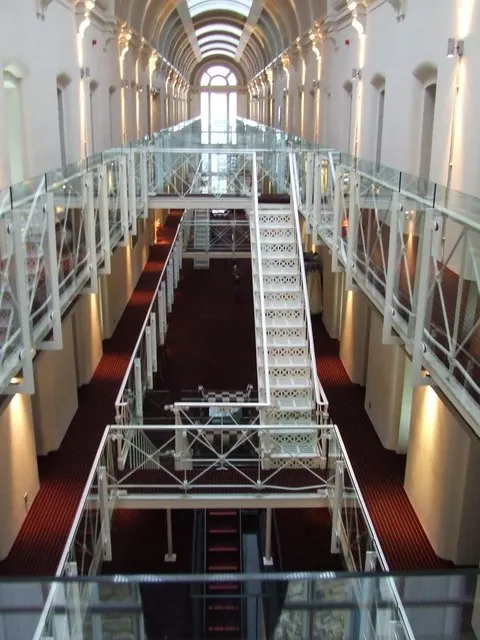
Photo: Richard cattel, CC BY-SA 2.0, via Wikimedia Commons
There's a certain kind of escape room that announces itself with a strip light, a laminated health-and-safety sheet and the smell of new carpet. Nothing wrong with that. But there's another kind, and it starts working on you in the car park: thick stone walls, a gate that clangs, windows you can't quite see out of. In 2026, a decent slice of the UK's escape scene has set up shop in buildings that were doing something far less fun a century or two ago — and it changes the hour completely.
Why a building with a past does half the work
Immersion is normally the designer's job. They paint, they dress, they pipe in sound. When the venue is a Victorian prison wing or a cold-war bunker, a lot of that is already done for them, and it shows in the details you can't fake: the echo in a stone corridor, the way a cell door shuts with a noise that means it, the fact that the room is genuinely two degrees colder than the street outside.
It also changes the puzzles. Heritage buildings come with rules — no drilling into seventeenth-century oak, no screwing brackets into listed plaster, no rewiring anything that a conservation officer has opinions about. Designers work around that with chains, padlocks, furniture, documents and hidden compartments instead of the magnetic reveals and servo-driven trickery you get in a purpose-built unit. Different flavour, not a worse one. If anything, it tends to push a game back towards proper, hands-on puzzling.
The prison circuit
The most common historic setting, and the easiest to find. Former gaols have the lot: cell blocks, exercise yards, visiting rooms, and a natural narrative excuse for why you're locked in.
- Shrewsbury Prison, Shropshire — a huge Victorian prison that runs tours alongside escape-style games in the old wings. Big day-out energy, and the town itself is a nice wander afterwards.
- Bodmin Jail, Cornwall — eighteenth-century prison with a seriously grim history and an attraction attached. Great if you've got a mixed group where half want spooky and half want puzzles.
- Crumlin Road Gaol, Belfast — a proper city-break option, with the added bonus of a decent pub scene within walking distance.
One caveat worth repeating: historic venues rotate games, run some seasonally and occasionally pause them for events. Check what's actually on before you build a day around it rather than assuming last year's line-up still stands.
Bunkers, tunnels and concrete
Cold-war bunkers and underground spaces are the connoisseur's choice. They're usually dim, they're usually chilly, and they have an atmosphere that no amount of set dressing can buy — that slightly clammy, humming, nobody-can-hear-you-scream quality. Scotland's Secret Bunker near Anstruther in Fife is the classic example of the genre, and even where a site runs more of a heritage tour than a game, it's a brilliant pairing with an escape room elsewhere in the region.
Tunnels and caves are the other end of it. Brilliant fun, terrible for anyone who doesn't like enclosed spaces, and worth a very honest conversation with your group before you book.
Castles, mills and merchant houses
Castle-adjacent games tend to lean on spiral stairs, thick doors and a lot of vertical walking. Mills and old warehouses give you low beams, uneven floors and rooms that are long and thin rather than square — which quietly changes how a puzzle flows. Merchant houses and old schools sit somewhere in the middle.
The practical upshot is the same across all of them: you will move around more than you expect, and you will not be doing it on a flat, wipe-clean surface.
What to ask before you pay
Five questions, every time.
- Is the game actually in the historic bit? Some venues are housed in an old building but run the game in a modern extension out the back. Ask. Both can be good, but only one is what you're booking for.
- Stairs, thresholds and low beams? Essential if you've got anyone with mobility issues, anyone tall, or anyone who's recently discovered their knees are mortal.
- What's the maximum team size? Cells are small. A game that says up to eight can feel like a rush-hour Tube carriage at eight.
- Is there a tour or attraction bundled in? A lot of these sites sell a combined ticket, and it usually works out cheaper than booking the two separately.
- Where do we park, and where do we eat afterwards? The second one matters more than the first. A day out is a day out.
A shape for the day that actually works
Do the history first and the game second. A morning tour of the building gives you the layout, the stories and the vocabulary, and the escape room then feels like a payoff rather than a warm-up. Lunch in between. Debrief in a pub after, ideally one with a fire and a menu that doesn't apologise for itself.
If you're travelling any distance, aim for a game starting no later than early afternoon — the last slots at popular venues go quickly at weekends, and a 5pm start in a cold stone building with a two-hour drive home is nobody's idea of a treat.
Kit and clothing notes
Layers, always. These buildings are draughty in a way modern venues simply aren't, and standing still puzzling for twenty minutes is when you notice it. Flat shoes with a bit of grip, no long trailing coats, and leave the chunky jewellery at home. Most sites won't let you take a torch or a phone in anyway, which is rather the point.
One more thing: arrive early. Old buildings are often awkward to find, parking is frequently a municipal car park four minutes' walk away, and a team that arrives flustered and late starts the clock already behind.
The bottom line
If your group has done a few rooms and the format is starting to feel samey, a game in a building with a past is the reset. You get the puzzles you came for, plus an hour in a space that feels like it means something — and a day out with a bit of shape to it, rather than a dash to an industrial estate and back. Just ring ahead, ask the five questions, and pack a jumper.